


Unified Communications auf Basis von gebündeltem DSL, UMTS und LTE
Kommunizieren als wäre man vor Ort
Unified Communications steht für die Konvergenz unterschiedlicher Kommunikationskanäle: von der E-Mail über Instant Messaging, Presence Management, Telefonie - ob VoIP oder klassisch, ob mit Bild oder nur mit Ton - bis hin zu anspruchsvollen und datenintensiven Anwendungen wie Data- und Webconferencing.
Ihre Vorteile durch Unified Communications auf Basis der Bündelung von DSL, UMTS und LTE:
- Gebündelte Übertragungsmedien sind das adäquate Vehikel für gebündelte Kommunikationskanäle
- Viprinet bietet mit seinen fein granularen und frei konfigurierbaren Quality-of-Service Klassen für jede Unified Communications Landschaft die richtige Bündelungstechnik
- Das einzigartige Latenzmanagement von Viprinet bürgt dafür, dass Kommunikationskanäle, die hinsichtlich der Signallaufzeit sensibel sind, auf die entsprechenden Medien gelegt werden
- Das integrierte "Traffic Shaping" eröffnet weitere Möglichkeiten der Steuerung der Bündelung. So wird jede Datenverkehrsart optimal transportiert.
- Ausfallsichere Verbindungen und redundante zentrale Komponenten (Hubs) sichern das Rückgrat der Unternehmenskommunikation mehrfach ab
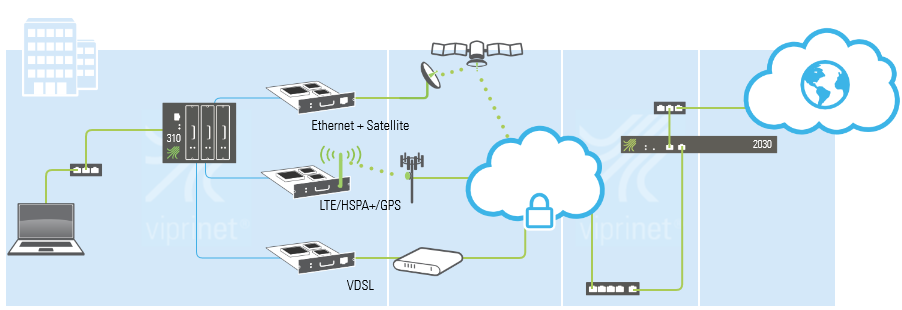
Unified Communications - die Kunst, unterschiedliche Medien und Daten optimal bündeln zu können
Unified Communications steht nicht für eine neue Technologie, sondern lediglich für die Konvergenz, die Zusammenführung von bereits etablierten Funktionen im Bereich der Kommunikation. Weshalb investieren Unternehmen und Organisationen in Unified Communications? Die Antwort: Weil Unified Communications für die standardisierte Einbringung von Kommunikationsfunktionen in die Geschäftsprozesse steht. Dabei spielt es keine Rolle, ob sich die Geschäftsprozesse nur innerhalb einer Organisation abspielen, oder ob sie Kunden, Geschäftspartner, Zulieferer oder andere Institutionen betreffen.
Je verteilter die Geschäftsprozesse sind, umso größer ist das Risiko, dass einzelne oder große Organisationseinheiten keine adäquate Netzwerkanbindung an die zentralen Unified Communications Systeme haben. Die Folge: Die Geschäftsprozesse können entweder nicht oder nur eingeschränkt laufen. Die Quality-of-Experience der Nutzer ist negativ, Akzeptanzprobleme sind die Folge. Damit wird der Hauptvorteil der Unified Communications, nämlich die enge Integration verteilter Organisationseinheiten, zunichte gemacht.
Viprinet bonds media such as xDSL2, 4G/LTE and 5G, in order for Unified Communications to be able to bundle multiple communications channels.
Unlike other providers, Viprinet has the ability to always adequately connect widespread organizations with its bonding technology. This applies to stationary connections (branch offices, remote facilities, etc.) as well as mobile units (land, sea, or air). The composition of the media and the configuration of the bonding can be matched exactly to the conditions and requirements of the site. This is possible because Viprinet bundles all available media like xDSL2, 4G/LTE, 5G, and satellite links in any combination to a virtual leased line that provides sufficient bandwidth, features high reliability, dynamically prioritizes WAN links as well as different types of traffic (QoS), und thus perfects the user experience. Without Viprinet bonding, Unified Communications is not fully implemented.